
Launch of the Normandy Impressionist Festival devoted to Monet’s legacy
29 May – 27 September 2026 | Official programme
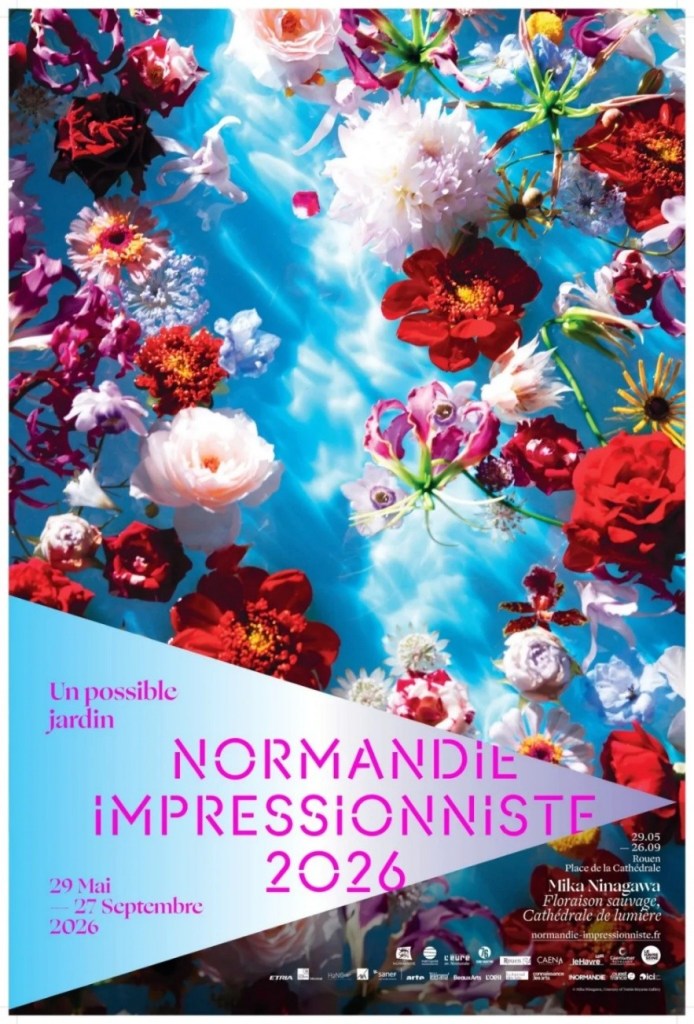
This year, the Normandy Impressionist Festival returns with an exceptional edition marking the 100th anniversary of Claude Monet’s death. For the first time in its history, the festival adopts a 100% contemporary programme, imagined as a dialogue between today’s artists and Monet’s revolutionary vision of nature, light and gardens. From historic cities to coastal landscapes, abbeys, gardens and museums, Normandy becomes a vast open-air gallery, inviting visitors to encounter contemporary creation in the very places that inspired the Impressionists.
The guiding theme of the 2026 edition, A Possible Garden, takes inspiration from Monet’s garden at Giverny, which he conceived as a work of art in its own right.
The festival offers a wide‑ranging programme including:
- Contemporary art exhibitions
- Outdoor installations and public artworks
- Concerts and live performances
- Cinema screenings and talks
- Family-friendly and hands-on projects
The festival unfolds across the entire region, connecting destinations through a shared artistic journey: Rouen, Giverny, Le Havre, Caen, Vernon, Honfleur, Deauville, Étretat, Lyons‑la‑Forêt, Cherbourg‑en‑Cotentin, the Mont‑Saint‑Michel and many more.
European Year of the Normans 2027: William the Conqueror’s Millennium
With a programme that promises to be on an exceptional scale, Normandy is gearing up for MILLENIUM 2027, the European Year of the Normans, and is already inviting visitors to immerse themselves in the treasures of medieval Normandy. Castles, abbeys and other iconic sites tell the stories of the Vikings, Richard the Lionheart and William the Conqueror through immersive tours and medieval festivals held throughout the year. Here, the remains of the Middle Ages are everywhere: along the Seine, nestled in the countryside, but also in the towns of the Medieval Village such as Rouen, Caen, Bayeux and Falaise.
The programme will bring together a series of major highlights at both regional and European level, including:
- An immersive exhibition on the theme of the great Norman epics
- A large gathering of Viking ships, a project born during a trip to Denmark by the Norman delegation
- A scripted quest, in which players seek clues and answers from 550 years of medieval Norman history, across Normandy and even Europe
- A contemporary art trail across Europe
- Monumental digital projections in Normandy and abroad
- Creation of a large-format textile work by artist Hélène Delprat, with the support of the Mobilier National, inspired by the missing scene from the Bayeux Tapestry
- Opening or reopening of museums in Normandy and Europe (Bayeux Tapestry Museum, Norman interpretation centre in Ireland, Viking Museum in Norway)
- The Bayeux Tapestry loan to the UK, with an exhibition at London’s British Museum opening early September 2026.
This initiative seeks to position Normandy at the heart of Europe and Europe at the heart of Normandy, while strengthening the attractiveness of its territories and fostering European and international cooperation in the cultural, economic and tourism sectors.
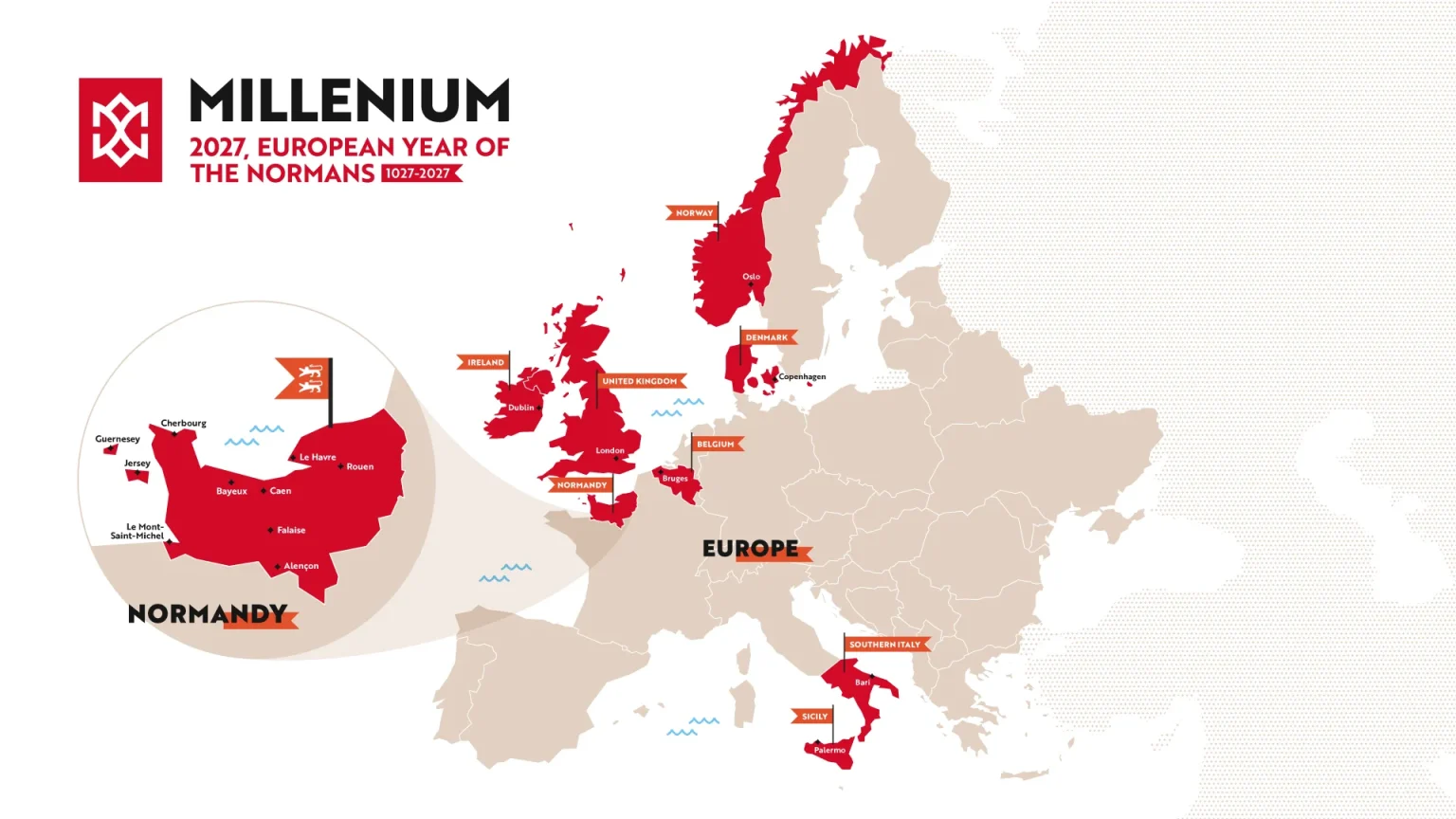
From 2028, the partners from these eight countries (pictured below) will submit a joint application for the The Council of Europe Cultural Routes (ICCE) labelling, inaugurating the “Route des Normands”.
The Bayeux Tapestry’s missing scene, now being woven in Aubusson
A Normandy delegation travelled to Aubusson to monitor the progress of the weaving of the missing scene of the Bayeux Tapestry, as part of the project led by the Normandy Region. This initiative is part of a large‑scale project launched by Normandy, in partnership with institutions Sèvres & Mobilier National. It aims to create a 25m² tapestry depicting the coronation of William the Conqueror at Westminster Abbey on 25 December 1066, a scene absent from the original artwork.
To bring this moment to life, French artist Hélène Delprat has been named by the municipality of Normandy and the French Ministry of Culture to add a representation of that climactic missing scene to the artifact, which is technically an embroidery but is still widely referred to as a tapestry. The weaving has been entrusted to the Atelier Tapisserie Guillot in Aubusson, a family workshop founded in 2001 by Patrick Guillot.
The finished tapestry will be unveiled and exhibited in 2027 at the Château de Falaise, birthplace of William the Conqueror.

